Disclaimer For educational purposes only. Do not use as medical advice
AboutChinese MedicineCaution/Notes
| Health Benefits |
| For: Chest tightness • Angina Pectoris • Coronary Heart Disease • Chest Pains • Rheumatic Heart Disease • Dry Heaves • Warmth in the Chest |
| Atributes: |
| Category: Regulate Blood ⌕ |
| Subcategory: Invigorate Blood and Dispel Blood Stasis ⌕ Source: Yi Lin Gai Cuo |
| Actions: Invigorates blood • Dispels blood stasis • Spreads liver qi • Unblocks channels • Moves Qi up/down • Stop pain |
| Diagnosis |
| Tongue: dark red • purple • dark spots on the sides Pulse:choppy • tight • wiry Other: |
| Patterns: Blood stagnation, Blood stasis, Qi stagnation, Blood Stagnation [hiccup, menses headache] |
| Indications: Blood stasis with Qi stagnation in the chest [35] • Blood stasis in the chest area (above diaphragm), chest pain, headaches[31] • Chest and hypochondriac pain, chronic & stubborn headache with a fixed piercing quality, dry heaves, choking sensation while drinking, depression, irritability, insomnia, palpitations, mood swings, evening tidal fever, warm sensation in the chest, incessant hiccup [Bensky] • Menses Headache blood stasis |
| Contraindications: Pregnancy, weak constitution, bleeding disorders |
| Description |
| Name Variations: Xue Fu Zhu Yu Tang, 血府逐瘀汤, Drive Out Stasis in the Mansion of Blood Decoction, |
| Herb List: Tao Ren(K, 12g) • Hong Hua(K, 9g) • Chuan Xiong(M, 4.5g) • Chi Shao(M, 6g) • Chuan Niu Xi(M, 9g) • Dang Gui(A, 9g) • Sheng Di Huang(A, 9g) • Chai Hu(A, 3g) • Jie Geng(A, 4.5g) • Zhi Ke(A, 6g) • Gan Cao(E, 6g) |
| Commentary: Mostly a combinations of Tao Hong Si Wu Tang and Si Ni San • Tao Ren and Hong Hua are chiefs and good for removing blood stasis. • Chi Shao, Dang Gui - invigorate blood lower body • Sheng Di Huang-nourish blood, clear heat • Dispel blood stasis without injuring yin and blood• Chuan Niu Xi - downward movement of blood • Chai Hu, Jie Geng, Zhi Ke - moves Qi, especially smoothing LV Qi • Jie Geng - ascending Qi to Upper Jiao.[Song] |
Related Formulas: Xue Fu Zhu Yu Tang, Bu Yang Huan Wu Tang, Ge Xia Zhu Yu Tang, Tong Qiao Huo Xue Tang, Tao Hong Si Wu Tang, Shen Tong Zhu Yu Tang, Fu Yuan Huo Xue Tang, Shao Fu Zhu Yu Tang
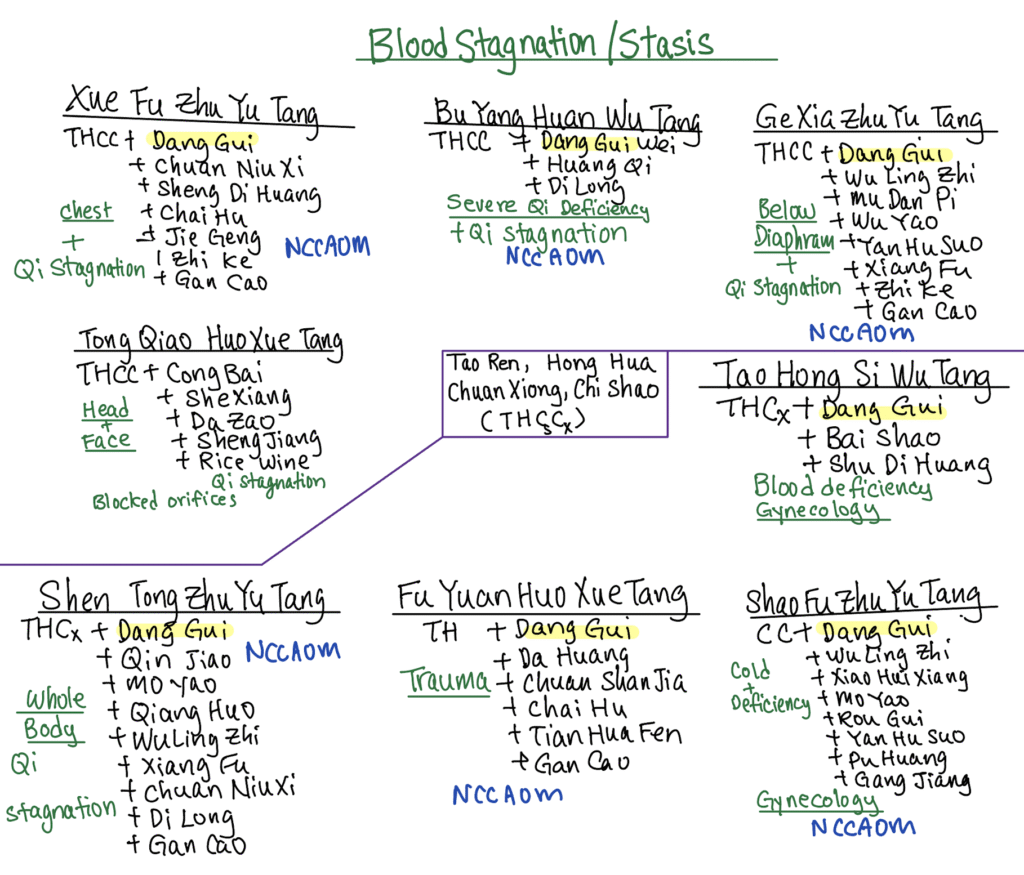 |
| NCCAOM: There are 12 NCCAOM formulas for Blood Stasis. They are Táo Hé Chéng Qì Tāng, Xuè Fǔ Zhú Yū Tāng, Gé Xià Zhú Yū Tāng, Shǎo Fù Zhú Yū Tāng, Shēn Tòng Zhú Yū Tān, Bǔ Yáng Huán Wǔ Tāng, Fù Yuán Huó Xuě Tāng, Wēn Jīng Tāng, Shēng Huà Tāng, Guì Zhī Fú Líng Wán, Shī Xiào Sǎn, Dān Shēn Yǐn. • Tao He Cheng Qi Tang is for Lower Jiao blood stasis + heat. Gynecological issues like PCOS, endometriosis, amenorrhea, dysmenorrhea. Differentiating factor is normal urination since this blood stasis does not impact the bladder • Xue Fu Zhu Yu Tang is for the chest blood stasis + Qi stagnation (headaches, insomnia, choking sensation when drinking, palpitations, menses headaches) • Ger Xia Zhu Yu Tang is for the epigastrium blood stasis + Qi stagnation (menstrual cramps, urinary pain not related to UTI, hypochondriac pain) • Shao Fu Zhu Yu Tang is for lower abdomen blood Stasis + cold stagnation (menses lumbago, 3-5 periods per month, infertility, menstrual cramps, amenorrhea from cold. • Wen Jing Tang is for menses issues related to Chong + Ren Blood stasis + Deficiency Cold (persistent scanty bleeding, irregular schedule. True cold false heat). • Sheng Hua Tang is for postpartum lochia retention due to Blood + Cold stagnation • Gui Zhi Fu Ling Wan is for blood stasis in the uterus during pregnancy (tumor, uterine bleeding, restless fetus). • Shi Xiao San is for lower abdominal blood stasis causing pain like PMS. Acute colicky pain in lower abdomen, middle abdomen or epigastric pain. Dysmenorrhea from LV Blood Stagnation. The previous 8 formulas all deals with some form of gynecological disorders. The remaining 4 deals with different aspects of the body. • Shen Tong Zhu Yu Tang is for channels/collateral (whole body) blood stasis + Qi stagnation. For chronic whole-body ache. • Bu Yang Huan Wu Tang is for Hemiplegia from Qi/Blood stagnation + Qi deficiency. Especially for post stroke sequela symptoms of fatigue, facial paralysis, speech impairment, dulled mental ability. • Fu Yuan Huo Xue Tang is for blood stasis + Qi stagnation in the trunk from traumatic injuries • Dan Shen Yin is for chest pain from Blood + Qi Stagnation. For heart attacks, CVA, chest pain, angina, chest pain or epigastric pain that radiates to the chest. |
| Herbs |
Cat/Dosage |
Actions |
Attributes |
| Tao Ren • Peach Kernel • 桃仁 ♠ |
Invigorate Blood
12g |
Break up blood stasis • Invigorate blood • Treat abscess • Moisten intestines • Unblock bowels |
antithrombatic • anti-inflammatory • antitussive • antiallergic • antiparasitic |
| Hong Hua • Safflower Flower • 红花 ♠ |
Invigorate Blood
9g |
Invigorate blood • Unblock menses • Dispel blood stasis • Relieve painHong Hua is better at dispersing blood stagnation to open channels/collaterals and extremities pain • Tao Ren better for blood stagnation in the abs and for lung and intestine abscess |
antiplatelet • antithrombatic • heart stimulant • CNS suppressant • uterine stimulant • adaptogenic |
| Dang Gui • Chinese Angelica • 当归 ♥ |
Tonify Blood
9g |
Tonify blood • Move Blood and Qi • Regulate menses • Invigorate blood • Dispel cold • Unblock bowels • Reduce abscess swelling • Alleviate pain • Clear pus • Generate flesh • Moisten intestines Dang Gui Shen (body) - tonify blood • Quan Dang Gui - harmonize blood (tonify and invigorate) • Dang Gui Wei (tail) - invigorate blood • According to the Board Exams, this herb does not affect estrogen because it has not yet been determined in which way it does affect it. However, there are numerous research articles on Dang Gui and estrogen. |
phytoestrogen • antispasmodic • cholagogue • antibaterial • antiviral • antiobesity • anti-inflammatory • antifungal • mild laxative • immune system boost • volatile oil inhibits uterine contractions |
| Chuan Xiong • Szechuan Lovage • 川芎 ♠ |
Invigorate Blood
4.5g |
Relieve pain • Expel Wind • Invigorate blood • Moves qi • Guide herbs to Jue Yin JingDao Di: Si Chuan • Available as injections |
Anticoagulant • Antiplatelet • Analgesic • Antitussive • Anti-inflammatory • Hypotensive • Sedative |
| Chi Shao • Red Peony Root • 赤芍 ♥ |
Invigorate Blood
6g |
Clear heat • Cool blood • Invigorate blood • Dispel blood stasis • Clear liver fire |
antiplatelet • antithrombatic • antibiotic • CNS suppressant • sedative • antipyretic • antiseizure • antispasmodic |
| Chuan Niu Xi • Cyathula • ⽜膝♥ |
Invigorate Blood
9g |
Move blood downward • Guide herbs downward • Invigorate blood • Dispel stasis • Tonify Liver • Tonify Kidney • Strengthen bones and sinews • Clears damp heat in lower jiao • Expel wind • Drain dampness • Promote blood circulation |
emmenagogue • vasodilator |
| Chai Hu • Thorowax • 柴胡♣ |
Release Exterior Wind Heat
3g |
Harmonize interior and exterior • Reduce fevers • Reduce chills • Soothe liver Qi • Clear muscle layer heat • Tonify stomach Qi • Guide herbs to Shao Yang Jing |
Antibiotic • Antipyretic • Anti-inflammatory • Antibaterial • Antiviral • Analgesic • Hepatoprotective • Immunemodulatory • Chemoprotective • Anti-tumor • Cholagogic • Sedative • Immunostimulate |
| Jie Geng • Platycodon Root • 桔梗♣ |
Phlegm Cold
4.5g |
Disperse Lung qi • Expel mucus • Soothe sore throat • Guide other herbs to upper body • Treat abscesses • Move Qi upward • Guide herbs upward |
Expectorant • Hypoglycemic • Anticholesterol • Antifungal |
| Zhǐ Ké • Ripe Bitter Orange • 枳壳 ♣ |
Regulate Qi
6g |
Dissolves Qi stagnation • Clear congestion • Relieve abdominal distention For moving Qi: Epigastric area - Chen Pi • Intestinal area - Mu Xiang • From epigastric all the way to the abdominal area - Zhi Shi and Zhi Ke • Lateral side area -Chai Hu, Xiang Fu, Qing Pi, and Fo Shou • Lower abdomen: Wu Yao warms kidney • Upper chest area: Tan Xiang, Xie Bai • REN4 & REN6 area: Chen Xiang |
antiplatelet • antithrombatic • hypertensive • diuretic • bronchodilator • antineoplastic |
| Sheng Di Huang • Rehmannia • 生地黄♣ |
Clear Heat Cool Blood
9g |
Clear heat • Cools hot blood (nosebleeds, bloody vomit, bloody urine, bloody stool) • Nourish Yin • Clears heart heat/fire • Generate fluidsDao Di: He Nan |
Immunity booster • coagulant • antidiabetic • hepatoprotective • hypotensive • anti-aging • antioxidant • antihistamine • emmenagogue • adrenalcortical |
| Gan Cao • Licorice Root • 甘草♣ |
Tonify Qi
3g |
Tonify Spleen Qi • Tonify Heart qi • Clear heat • Resolve toxicity • Stop cough • Dispel phlegm • Lubricate lungs • Stop wheezing • Reduce spasm • Relieve pain • Harmonize other herb effects • enters 12 channelsEnters all 12 channels, often serve as envoy in a formula. |
Hypoglycemic • Antiarrhythmic • Hypertensive • Expectorant • Antidiarrheal • Antiulcer • Hepatoprotective • Immunostimulant • Antitussive • Antiviral • Detox • Demulcent • Anti-inflammatory • Laxative • Emmenagogue • Antimicrobial • Spasmolytic • Corticosteroidal |
| ♠ King/Chief ♥ Minister/Deputy ♣ Assistant ♦ Envoy |
| Directions: While the original formula calls for Niu Xi, it's usually Chuan Niu Xi that is used. |
| Modifications |
For |
| + Man Jing Zi + Bai Ji Li |
Headaches |
| + Yi Jin + Xie Bai |
Pain in the hypochondria |
| + Yu Jin + Dan Shen |
Abdominal masses |
| – Jie Geng + Xiang Fu + Yi Mu Cao |
Amenorrhea or dysmenorrhea 31 |
| – Chuan Niu Xi – Jie Geng |
Rheumatic heart disease |
| + amount of Hong Hua, Chuan Xiong, and Dan Shen |
Angina pectoris from coronary artery disease |
| + Quan Xie + Wu Gong + Di Long + San Leng + E Zhu |
Chronic pain with disease deep in collaterals 31 |
| + Chuan Lian Zi + Qing Pi + Xiang Fu |
Severe Qi stagnation 31 |
| + Dan Shen + Yu Jin + Mang Chong + Shui Zhi |
Hypochondrium mass accumulation 31 |
| Caution |
- Do not use during pregnancy
- Do not use with heavy menstrual flow
- Do not use when there are signs of hemorrhaging present.
- Do not combine with anti-coagulant drugs
ALERT: Contraindications of each herb - use with caution under these conditions:
Tao Ren: Pregnancy • Blood deficiency • Anticoagulant or anti antiplatelet drugs
Hong Hua: pregnancy • anticoagulant and antiplatelet drugs
Dang Gui: Autoimmune disorder • Pregnancy • Blood thinner drugs (Wafarin) • Diarrhea • Yin deficiency with heat • Dampness abdominal distention
Chuan Xiong: Pregnancy • Blood thinners • Fire from yin deficiency • Dry tongue • Dry mouth • Fever • Profuse menstrual bleeding • Spleen deficiency • caution: LV yang xu since this herb tends to move Qi upward.
Chi Shao: Pregnancy • Incompatible with Li Lu • Deficiency cold • Antiplatelet and anticoagulant drugs
Chuan Niu Xi: Pregnancy • Menorrhagia • Spleen deficiency diarrhea • Kidney Qi deficiency with excessive menstruation • Spematorrhea
Chai Hu: Dries Yin and can exacerbate the Yin deficiency • Do not use as intramuscular injections • Liver fire • Hyperactive liver yang • Cytochrome P450, 2C9, 2E1, 2D6, and 3A4 • Greater than 19g may lead to liver injury
Jie Geng : Blood-stained mucus • Hypoglycemia • Tuberculosis • Anti-diabetic drugs
Zhǐ Ké: pregnancy • anticoagulant or antiplatelet drugs • Spleen/Stomach deficiencies • gastric ulcers • duodenal ulcers
Sheng Di Huang: Yang deficiency • Blood deficiency • Spleen deficiency • Stomach deficiency • Can be sticky and cloying, careful with digestive disorders • food: onion, garlic, radishes
Gan Cao: High blood pressure • Low potassium • Seaweed • Medications: Gan Cao can interact with various medication. See Pharma Interaction section. |
| Notes |

Attachment formulas: Tong Qiao Huo Xue Tang, Ge Xia Zhu Yu Tang, Shao Fu Zhu Yu Tang, Shen Tong Zhu Yu Tang. Shen Tong Zhu Yu Tang is for whole body ache, particularly the limbs and back. (drawing credit: Lindsay Kunz) |


0 Comments